Showing posts with label China. Show all posts

Wednesday, January 18, 2017

The New China

Street view in Beijing
Beijing street at sunset (May 27, 2016)

When I was a kid, I was in awe of the globetrotting traveling life of my uncle. He spent all his vacations traveling to what for me were the most exotic destinations: India, the Canary Islands, the Galapagos, and of course China. Since these travels happened more than forty years ago, the China he visited was very different from the current one. It was a China of large avenues full of bicycles, and very few cars. It was a China where most people were wearing uniforms, and the cult of Mao was very strong. It was also a China that one could visit only in very controlled settings, with minders following at every single step, and deciding what you were allowed to see, and what not.

Busy street in Beijing (May 27, 2016)
Busy street in Beijing
This is far from the China that I visited in 2016. The new China is a modern country with congested cities, a lot of cars, and a semi-perennial cloud of smog (although, in all fairness, I was very lucky during my trip and I got to see a lot of blue skies). Walking the busy streets of Beijing one has the feeling of being in any contemporary western city. You can still see the remnants of an epoch almost completely gone, like the old traditional neighborhoods that still border the walls of the Forbidden City, but that have been mostly razed and replaced by modern blocks of high rise apartments. The Beijing of 2016 looks very much like a city projected towards the future.  Yet, one may question what this future will be. Talking with the expat community it seems clear that something has changed in recent years. Especially in the humanities, I heard people complaining of new restrictions in their academic activities that didn't exist a short while ago. Even the independent parties whose existence is allowed by the government seem to have a shorter leash than before. The country seem to be firmly on an authoritarian trajectory. (*) How much this will affect the economic boom and the technological and social explosion that China is currently experiencing, it remains to be seen.

(*) As I am revising these notes in December 2022, I can now fully appreciate how my expat sources were right in describing the authoritarian trajectory of the country, with a progressive concentration of power in the hands of a single person, and stronger restriction on the Chinese society that have existed for decades. As I am writing this footnote there are large protests even close to the center of power against the Covid-zero restrictions that the country has implemented in the futile effort to close its border to the virus that escaped from China itself two years before. Will these protests stop, once these restrictions are mitigated, or will the seed of protest expand to reclaim more aspects of the open society that have been lost in recent years?
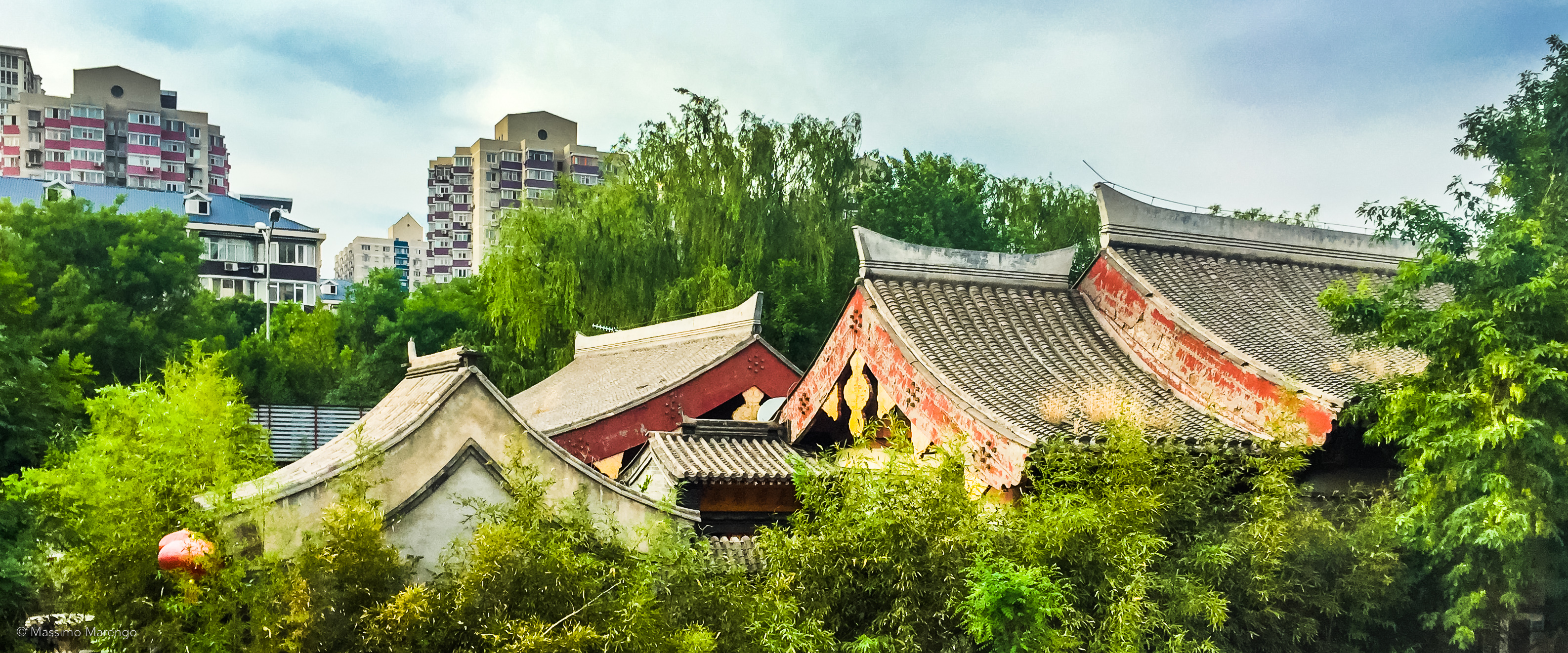
Old and new in Beijing (May 27, 2016)
Old and New in Beijing (May 27, 2016)


Monday, January 16, 2017

Walking on the Wall

Mutianyau Great Wall, China (May 28, 2016)

The advantage of the Mutianyau section of the Great Wall, with respect to the more popular Badaling, is that Mutianyau is less frequented, and is possible to find views of the Wall unobstructed by crowds.

Walking on the Wall
The restored section of the Mutianyau Wall is 2.5 km long, and includes 23 towers spaced about 100 meters from one of the other. The Wall itself is designed as a raised road, allowing watchmen to easily run from one post to the other in what would otherwise be an impervious mountainous terrain. This allowed to keep under control a vast border with a minimum amount of troops. Some of the watchtowers have a flat top, with a space designed to hold a fire that could be easily lit to alert the main garrison stationed in the valley in case of a mongol incursion. It is said that this fire was made using wolf scats, for their property of producing dark dense smoke easily seen from a large distance. Even as we were visiting, the Wall undergoes continued maintenance. In fact most of the mason work is not original, but reconstructed according to the original design of the wall: only in a few places large panel of glass allowed to see the remnants of the original wall embedded in the modern reconstruction. Towards the end of the restored section of the Wall there is a 200 meters long writing on the mountain: 忠于毛主席, which means "loyalty to Chairman Mao". As I mentioned in a previous post, visiting the Wall is considered a civic duty in China. 

We spent several hours walking on the broad stone roads built on top of the Wall, without covering the whole length of the restored section. The sight of the Wall, and the views of the landscape around it, are very impressive, and certainly justify the visit, even though a different time in the year, maybe in spring or autumn, is advised to avoid the hot sun that relentlessly accompanied our tour.

Mutianyau Great Wall, China (May 28, 2016)

Sunday, January 8, 2017

Visiting the Great Wall

Mutianyu Great Wall, China (May 28, 2016)

Flying to China from the US is expensive, especially if one is forced to use american carriers to get travel reimbursement from work. One way to reduce the cost is to relax the constraints on the traveling dates, in order to get the cheapest available flights. It turned out that paying the hotel for one day more after the end of the conference was cheaper than returning the same day. So, I ended up having an extra day to kill in Beijing: perfect occasion to visit a nearby section of the Great Wall.

On the bus to Mutianyau
The Great Wall was built starting from the 7th Century BC, even though little remains of the most ancient parts of its construction. The majority of what survives today is from the Ming Dynasty (1368-1644). The wall was built to control the northern access of China, and to contain the raids from the nomadic hordes living in the northern Mongolia steppes. Overall the actual wall is long more than 6,000 km (almost 4,000 miles), but extends much more if one includes trenches and natural defensive barriers. Most of the Ming Great Wall has now disappeared, a victim of the ravages of time and history. A few sections however have been restored and are now visited by million of tourists every years, many of them Chinese. Visiting the Great Wall is in fact considered a patriotic duty by the Chinese. This may be due to a quote attributed to Chairman Mao: "If you have never been to the Great Wall you are not a real man". Truth is however a little more complicated, as the quote is only the third verse of a poem Mao wrote in 1935 to inspire men and women to complete the Long March:
The heavens are high, the clouds are pale,
We watch as the wild geese disappears southwards,
If we fail to reach the Great Wall we are not true men,
We who have marched more than 20,000 li.
Mutianyau
The isolated sentence may have lost its original meaning, but is nevertheless very effective to promote Chinese tourism to the wall (street vendors offer you a "certificate" if you walk along the wall), especially the Badaling section, the first to be restored in 1975. That section of the wall is the easiest to reach from Beijing, 80 km north of the city and well served by public transportation. It is also the most crowded, so we decided to visit another section, near the fruit producing area of Mutianyau (about the same distance from Beijing than Badaling, but no easy public transportation). Arranging that is not difficult (plenty of travel agencies with english-speaking personnel), as long as you are careful to avoid the "cheap" trip offered by the hotels, which inevitably end with a long stop at a local mall. After some searching we chose to hire a trip with tour-beijing.com, offering "Mutianyau no-shopping tours" for $64 each person (we were 10, so we ended up hiring an entire minivan and private tour guide for that price). The bus picked us up at 8AM, right in front of the hotel, for the 1.5 hours ride to reach the wall (if there is not much traffic, which is instead expected in the morning).

Huge apartment blocks
You can see our guide in the small photo above on the left: she was actually living in the area near Mutianyu and had to leave very early in the morning to pick us up at the hotel. The bus ride was comfortable, but we indeed ended up stuck in highway traffic for half an hour or so. The difficult part was to getting out of the city, an endless expanse of high rise apartment blocks, many of them built surrounding what looked like a factory or assembly plant of sort. One can only appreciate the huge size of Beijing by driving through its never-ending outer suburbs. Once we managed to escape the traffic of the city the flow in the highway became easier, and we drove through a pleasant countryside full of orchards (the area North of Beijing is famous for its fruits production). Until we finally reached the mountains. 

Chairlift to the wall
The wall is a big touristic attraction and its access is well organized. The bus left us at the base of the mountains, where we got a chairlift to the wall, a few hundred meters above (some of us elected to walk on a steep path in the forest). The chairlift (small photo on the right) is actually quite nice, and it affords an unobstructed view of the wall which you cannot have from the wall itself (see large photo above). Once on top, you walk. I will write more extensively of the wall hike on a separate post, but for now I would just remark that even this short restored segment of the wall is actually very long, more than enough to satisfy any wall-walk urging I had, especially considering that any step forward must then be retraced back to the chairlift station, to get back to the bus at the end of the day. Notice however that in the photo on the right the chairs coming down were all empty. That is because the fun way to get back to the base is not with the chairlift, but rather with a very long toboggan.You sit on a small wheeled cart, pull up the brakes and slid all the way down as fast as you trust the centrifugal force to keep you within the banked tracks in the curves (or as fast as the person in front of you). It was indeed quite fun.

Beijing highway (May 28, 2016)

Monday, January 2, 2017

A Neighborhood Park

Yuandadu Relics Park, Beijing, China (May 27, 2016)

The last day of the meeting we finished early enough that I had the late afternoon free for a stroll in the Haidian district, where my hotel was located. I decided to go to what looked like a nice neighborhood park, along a canal in-between the 3rd and 4th ring roads.

Prosperous Dadu Sculpture
As many things in China, the park turned out to be huge! With a total length of 9 km, the Yuandadu Relics Park is the largest zonal park in Beijing. In this late Friday afternoon I visited it was very well frequented by the people living in the district. Many families and retirees, walking around or sitting on the benches reading a book or playing an instrument. And a large crowd very committed in watching what looked like some sort of gambling activity based on cards. The canal along which the park is established, as well as the many fountains in the park, were drained for maintenance the day I visited; they must be quite a view when the water is flowing. The park has many fruit trees that were being harvested by the park visitors; something that I am not used to see in the West but makes perfect sense if you think about it (why wasting perfectly good fruit?).

The name of the park derives by it location, on the grounds that were once occupied by the walls of Dadu (also known as Khanbaliq), the ancient capital city of the Yuan dynasty (1271-1378). Many of the ruins are still preserved, and there are several sculpture groups celebrating the past glory of the site.  The main sculpture (small photo above) represent the Yuan emperor Shizu (also known as Kublai Khan) in his howdah. He is surrounded by the the great astronomer Guo Shoujing, the Nepalese architect Araniko and the Italian traveler Marco Polo: who would have thought that I would have found a piece of Italy in the core of Beijing?

Yuandadu Relics Park, Beijing, China (May 27, 2016)

Friday, December 16, 2016

The National Museum of China

National Museum of China, Tiananmen Square, Beijing, China (May 22, 2016)

With over 2,2 million square feet of display space, the National Museum of China is one of the largest in the world, and it is visited by 7.5 million visitors every year. The museum is on the east side of Tiananmen Square. Still tired after the long walk the day before, we decided to make it our destination, after strolling for some time under the Tiananmen Square relentless sun.

Terracotta Army
The museum is in fact two different museums combined. One part is dedicated to the history of China through the ages, literally, the first artifact being the 1.7 million years old Yanmu Man (元謀人). The other side is instead dedicated to a somewhat hagiographic portrait of the legacy of the Chinese Revolution. I don't need to tell you which side we visited... It was actually worth it. The collection of ancient artifacts, revealing how China had a very refined culture at time when our progenitors were still living in caves, is impressive. The bronze artifacts, in particular, are stunning: some of them are incredibly massive (there is a rectangular vessel weighting more than 800 kg), but at the same time have most delicate ornaments and inscriptions. Whoever made them really knew their craft. The museum has sections covering each and every dynasty in the long history of China. Each with a different style, a different concept of art. One small display has a sample of the famous "terracotta army", with one horse and two soldiers. I was happy to see it there since the whole thing is far from Beijing, impossible for me to visit during this trip.

Blue and white porcelain vase
A large section of the museum is dedicated to the ceramic wares. This is an art that China has been developing for tens of thousand of years, with the first pottery produced in neolithic times, almost 20,000 years ago. The blue and white porcelains (青花, literally "blue flowers") are the ones that I found more appealing, like the vase in the small photo on the right. This is a style that dates back from the 9th to the 14th century, when the blue pigment based on cobalt minerals were first imported from Persia. It is interesting how the technique, after being perfected by Chinese artists, found its way back to the middle east, inspiring a renaissance of ceramic production with islamic themes. The world is after all is small, and goes in circles... Other interesting sections of the museum were the one dedicated to the development of Chinese writing, and the innumerable artifacts with astronomical significance, like the many maps of the sky, with the stars grouped in the strangely familiar yet alien patters of the Chinese constellations. We spent the whole afternoon in the museum, until one by one our legs and backs started to give way to age (well, at least in my case), and we finally made our way back to the train station under Tiananmen Square, and to the hotel for dinner and the final rest before the first day of our conference meeting.

Floral Exposition in front of the National Museum of China, Tiananmen Square, Beijing, China (May 22, 2016)

Sunday, November 20, 2016

The Front Gate in Tiananmen Square

Zhengyangmen, Tiananmen Square, Beijing, China (May 22, 2016)

With one more day before the conference was scheduled to start, we went back to Tiananmen Square, this time taking the subway to the right stop. The square is indeed very large, and surrounded by a number of monumental building. To the north there is the main gate to the Forbidden City (see panorama below), the entrance we used the day before to visit the Palace Museum.

Mausoleum of Mao Zedong
On the opposite site there is the imposing Zhengyangmen (正陽門), or "the gate of the zenith sun". The gate once guarded the south entrance to the inner city, as part of Beijing historic city walls. The walls are now gone, but the gate is still an important geographic marker along the north-south axis of the city. First built in 1419 during the Ming dynasty, the gate guarded the entrance to the imperial city. In 1900 the gate was destroyed during the Boxer rebellion, when a Chinese militia rebelled against foreign imperialism and Christian missionaries. The rebellion was crushed during the battle of Beijing, when an Eight-Nation Alliance invaded the city: the tower played a prominent role during the fighting. Zhengyangmen was later reconstructed by the Qing dynasty, in direct violation of the Boxer protocol (one of the "Unequal Treaties" imposed to China by the invading powers). The tower of course is not the only prominent building in the square. The equally imposing Chairman Mao Memorial Hall (毛主席紀念堂) stands at the center of the Square, with the crystal coffin where the embalmed body of the "Great Helmsman" is visited by the millions (kind of ironic given that Mao himself wished to be buried). A very controversial historical figure abroad, Mao Zedong is still very popular in China.

Since it was built, the centrality of Tiananmen Square made it the stage of several important protests that happened on the site, the last of which the "June Forth Incident" (六四事件). These are the 1989 student's revolt that in the West are known as the Tiananmen Square protests, forcibly repressed by the government when it declared martial law. Access to the square is now heavily controlled, with fences and security gates along its entire perimeter, and plenty of security cameras (zoom-in at the lamp post in the photo on the left), in part because of the terrorist attack that killed 5 people in 2013.

Tiananmen Square, Beijing, China (May 22, 2016)

Sunday, October 16, 2016

Ancient Script

The Forbidden City, Beijing, China (May 21, 2016)

China is old. You won't realize it based on the modern buildings in the post-Olympics busy Beijing, but just enter in on one of the many pavilions inside the Palace Museum and you will breathe the air of history. The Forbidden City is actually one of the largest museum of the world, with 980 surviving buildings and 8707 rooms covering a total 720,000 square meters.

Ancient Script
This is much more than can be seen in just a brief afternoon visit, so we cherry-picked a few collections to visit, and that was still mind-blowing. I am not known to be a meticulous tourists, of the very organized sort that reads tons of guides and one month in advance of the trip knows the exact itinerary to maximize a visit. I do buy a guide or two, but then wait to the last minute before actually opening them, so that by the time of the tour I only have a sketchy idea of what I can see. Not the most efficient way, but on the other hand it leaves one's mind open to the surprise of discovery. This visit was no exception. It was also a hot day, and we had already walked a lot just to get to to the Forbidden City entrance, so it didn't take very long until we found ourselves looking for a cool place to rest. This is how we found a pavilion with the holy combination of shade, air conditioning, and an impressive collection of fine bronze utensils, musical instruments and weapons, some of them 5,000 years old.

Ancient Script
Several of the items were actually inscribed, with ancient characters that were at the same time familiar and novel. One example is in the photo above, that shows an example of such writing (on the left) with the corresponding modern characters. The resemblance is there, but the older version is more closely representing an actual drawing of the subject it portraits, while the modern equivalent is more stylized. The legendary origin of the Chinese characters refers to the mythical Cangjie (倉頡), the four-eyed historian of the equally mythical Yellow Emperor, the founder of Chinese civilization and the ancestor of all Chinese people. Legend has that Cangjie used his four pupils to see things that nobody else could see, including ghosts and deities, and was very observant. Tasked by his emperor to devise a method to record informations for posterity, he was inspired by the footprint of a pixiu (a winged lion), and created a large number of symbols to represent all things: the ancient Chinese script. Another version of the legend postulates that Cangjie was instead inspired by the veins in the shell of turtles: particularly interesting postulation, given that archeologists have unearthed fragments of turtle shells with actual writing on them. Whatever the inspiration, the legend of Cangjie would place the invention of Chinese writing around 2700-2600 BC, when the Yellow emperor reigned.

The earliest record of actual writing (apart from individual isolated signs inscribes on bones), however, go about as back as the Shang dynasty (about 1200 BC). One example is the inscription in the ox scapula shown in the small photo above (left), which I photographed the following day at the National Museum of China. That is where we will go in the next post.

The Forbidden City, Beijing, China (May 21, 2016)

Saturday, October 8, 2016

Forbidden City

The Forbidden City, Beijing, China (May 21, 2016)

The Forbidden City is BIG. After walking around its whole length along its perimeter wall and moat, we finally reached Tiananmen Square: there is where the South entrance to the Forbidden City is located, under a gigantic portrait of Chairman Mao, Mona Lina smiling at the long line of tourists clearing the security check leading to the red plastered walls of the monumental Gate of the Heavenly Peace.

The Inner Golden River
The Forbidden City had been the seat of Chinese imperial power for almost 500 years, until the 1912 abdication of Puyi, the last emperor of China. For the following twelve years the last emperor was confined in the Inner Court of the sprawling complex, while the Outer Court was, for the first time in history, opened to the public. This arrangement ended in 1924, when a coup ended once and for all the Qing dynasty and the imperial rule in China. The Japanese invasion, and then the Chinese Civil War caused many of the treasures in the Forbidden City to be evacuated. Much was returned at the end of War War II, but a small but highly valuable part of the collection is still missing, kept in the National Palace Museum in Taipei. In the years following the establishment of the People's Republic of China the palace was left in disrepair, and sometimes directly threatened of destruction, as during the Cultural revolution when in the eyes of the revolutionary zeal it became a symbol of the overthrown oppressive imperial power. It was only saved when the premier Zhou Enlai sent an army battalion to defend the city. In 1987 the Forbidden City was declared a World Heritage site and the Chinese government has finally recognized its cultural (and economic, given its value as a touristic attraction) importance. Now administered by the Palace Museum, it is undergoing a massive restoration project aimed to bring back the splendor of its buildings in their pre-1912 state (much has been already done, but we could see areas still fenced off as the works continue).

Even though only part of the complex is open to the public, the sheer size of the structure is too much to be visited in a single day. One walks from courtyard to courtyard, passing under one gate after the other in what is the largest collection of preserved ancient wood structures in the world. The courtyard opening on the Meridian Gate is so expansive that a wide canal flows through it, crossed by 5 marble bridges (the Inner Golden River, small photo on the left). With 14.6 million annual visitors (for what I could see, a large fraction of them are Chinese nationals, or come from nearby asian countries) it is the most visited museum in the world.

The Forbidden City, Beijing, China (May 21, 2016)

Saturday, October 1, 2016

Just Two Subway Stops to the Forbidden City

The Moat and Wall of the Forbidden City, Beijing, China (May 21, 2016)

China is 13 hours ahead of the time zone where I live, which is as bad as it gets since it completely invert the sleep/awake cycle. Being able to function after such a time slip requires some adjustment, so I planned to arrive in Beijing two days before the start of my meeting. Adjusting to a new time zone however works only if you resist hitting the bed during the day, and stuck to the sleep schedule of the new location. That means keeping busy while the internal clock gets in sync with the sun.

Forbidden City Moat
I decided to spend the first adjustment day visiting the Forbidden City, just a short subway ride from my hotel. It is in fact quite easy to move around in Beijing. The city has 18 lines, 334 stations and 554 km (344 miles) of tracks making the Beijing subway the second largest system in the world (after Shanghai). All this is quite recent, since only two lines where in operation before 2002, with the largest expansion was completed for the summer Olympics games hosted in 2008. Since I read about how imposing was the wall and moat surrounding the Forbidden City, I convinced my graduate student that went along for the trip that we should get off the train before the main entrance, and walk a little along the wall. According to my map that meant walking for just a couple of stops, strolling through a modern boulevard leading straight to the back side of the Forbidden City, and then walking along the moat to the main entrance facing Tiananmen square on the opposite side. The weather was pleasantly warm and sunny, and the air exceptionally clear, without the dense cap of smog that the city is notorious for. What could go wrong?

Well, what went wrong is that I apparently don't know how to properly read distances on a map. The distance between the two stops turned out to be over 3 miles, and took a couple of hours to navigate in the heavy traffic of the big city, to then arrive at the entrance of the Forbidden City, which is something that in itself takes at least a full day to visit. My graduate student was not amused, and she is still reminding me of this episode every time she want to point out how my judgment may not be up to the task when we explore new directions in our daily research work. From that point onward she got in charge of navigating our excursions on the city's transport system. The trick for a successful career in academia is finding students that are smarter than you...

The Moat and Wall of the Forbidden City, Beijing, China (May 21, 2016)

Saturday, September 24, 2016

Flying to the Far East

Somewhere over Iowa (May 19, 2016)

When I was a student in Pisa, I spent countless hours watching the world pass by, from the window of the intercity train that would ferry me back and forth between the city where I was studying, and the one where my family lived in the North of Italy. It seemed a very long trip at the time (about 200 miles that the train would cover in 4 hours), even though in my current midwestern frame of reference it is but around the corner. I relished watching the life of strangers pass-by from the second class window, like an unscripted movie pasted together by a director not quite awake from a surrealist dream. A way to suspend one's own thoughts by borrowing fleeting moments of other people's life.

Des Moines Airport
Since I came to the US, trains ceased to be my main method of transportation. The distances here are much larger than in Europe, and the trains themselves are just a shadow of their past glory, when they opened the Frontier to civilization (our particular variant of it) and genocide (of the people that had already civilized these wanted lands). In the US you either move by car, (the mechanical overlords that control America's suburbia commuters' life) or you fly. I started to fly a lot. To the observatories on top of remote desert mountains where I would use giant pieces of glass to pierce the sky (or, most often than not, the hated clouds) in invisible light. To far away cities where I would meet like-minded astro-obsessed individual, where we would discuss in conference the mysteries found in these observations. Even though the pace of my travel has decreased since moving to a University (teaching commitments) and since I started to use space telescopes (you don't really have to travel to space to use them), I still fly a lot. In about a decade I clicked over three quarters of a million miles, on just one of the many airlines that had been ferrying me around. This is more than 4 times the distance from the Earth to the Moon.

The next few posts will be about one of such trips. Mid-May this summer, as soon as the classes ended and the students were given to know their fate after the final exam, I packed my carry-on luggage and drove to the Des Moines airport, ready to fly to Beijing via Chicago. This was my first time in China, a country I had been always curious about, but never visited before. As I was traveling light, I made the objectionable choice of leaving my DSLR camera home. All the photos you will see in this series, including the ones in this post, were therefore shot as JPEG with an iPhone 6, and subsequently processed with Lightroom on my computer. In the next posts I will talk about the conference, and the places and people I visited in the trip. I hope you will enjoy coming along!

Chicago O'Hare Airport (May 19, 2016)