Showing posts with label Wildlife. Show all posts

Saturday, July 9, 2016

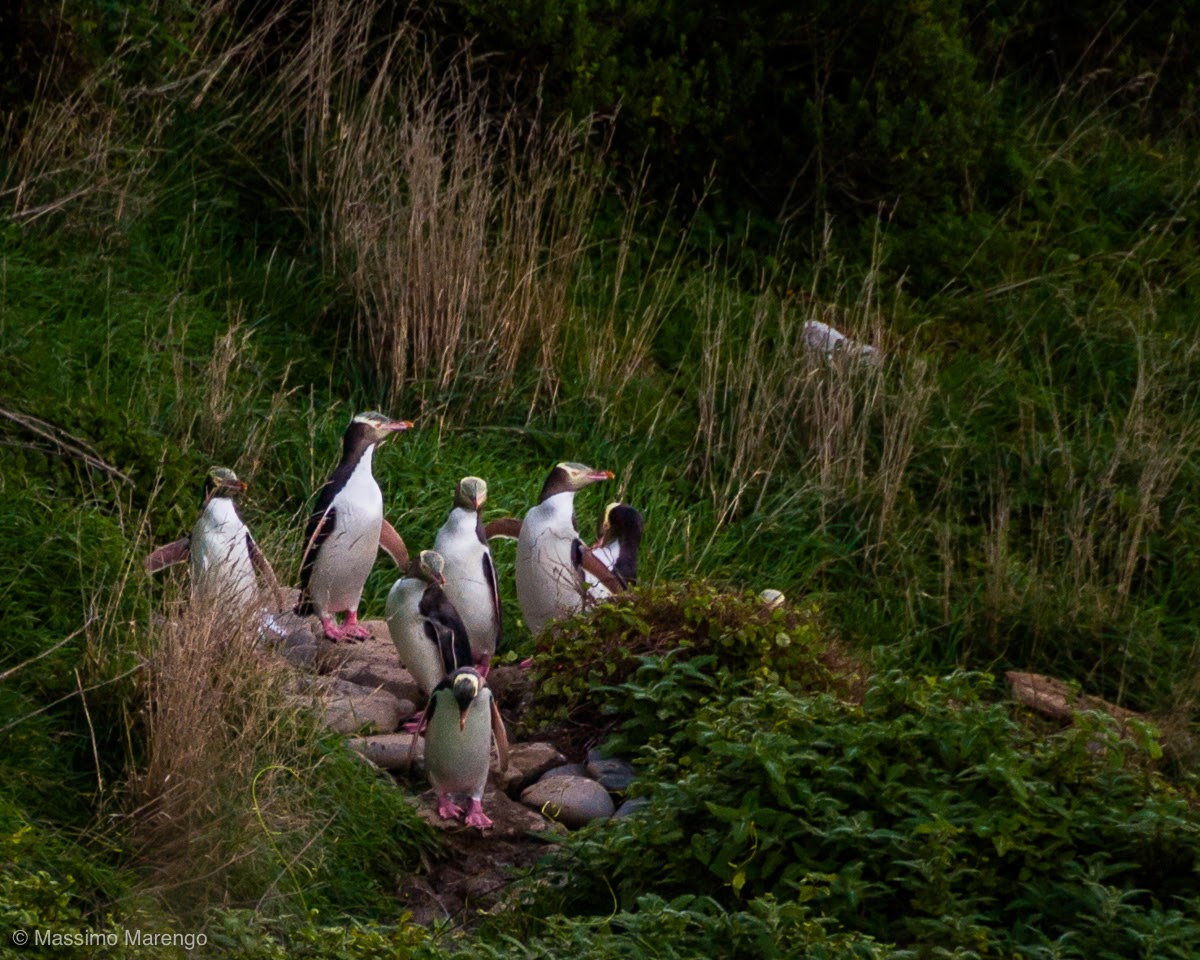
The Penguins at Nugget point

Nugget Point, New Zealand (Jun 4, 2008)


We arrived at Nugget Point that was getting dark. The main feature of this rocky headland is the white lighthouse (photos below), which is accessed from the main Catlins “highway” through an unpaved road closely following the coastline. The last part of this road is narrow and steep, in some points impressively so. Our rented Ford Focus seemed capable to negotiate the slope quite well, so we drove to the end (even though I was a little apprehensive at the idea of having to drive back in the dark). 

Nugget Point lighthouse
Just before the last curve we saw a sign about an “observatory” for the local colony of penguins. We stopped the car and walked on a narrow path leading to a wooden hut hanging to the cliffs. From the windows of the hut there was a good view of the beach and the grassy slope below. At first we didn’t see anything. Then, we saw a pair of yellow-eye penguins pruning, on a platform mid-slope. After a little while, we started seeing one, two, many penguins slowly and clumsily walking out of the water. One would expect penguins to be well adept in getting in and out of the water. Well, that’s not the case. These penguins seemed to do a huge effort to get on dry land, as for every two steps they were negotiating with the swell, the next wave would push them back one step. In the end a dozen or so congregated around the few boulders shown in the photo above. The individuals we saw were all adults, as shown by the yellow band circling around their neck (compare to the photo of the juvenile we saw at Akaroa Harbor). After spending the day at sea they were retreating on terra firma to rest for the night.

As we were watching them, it got dark to the point that making photos was getting impossible. We walked to the lighthouse and then back to the car, aware that we needed to drive 230 km more to get to Oamaru, were we intended to spend our last night in the South Island.

Nugget Point, New Zealand (Jun 4, 2008)

Saturday, May 14, 2016

Milford Deep

Milford Sound, New Zealand (Jun 3, 2008)

The fishes in the small photo below are Butterfly Perches, which are one of the many species living in the waters of Milford Sound. The white “branch” in the background is instead the very rare black coral (which is actually white, or bright colored, the black moniker due to the color of its skeleton). Black corals live only at great depths, but in Milford Sound can be found closer to the surface because of the unusual darkness of its waters. The steep walls of the mountains in the fiord are rich in vegetation, but lack soil. As a consequence, the rain washes all organic matters directly in the sound, which is rich of tannin. That makes the water very dark, and allows the growth of the black coral.

Butterfly perches and black coral
The photo was not taken in an aquarium, nor we did scuba diving. We would have liked to (we even brought our masks along, but time (lack of) and a persistent congestion prevented that. Plus the New Zealand seas are quite cold all year round, and we were in winter. We however did see the marine life of Milford Sound in its natural setting. The Milford Discovery Center and Underwater Observatory is a floating cylinder of concrete that is immersed over 10 meters deep in the sound. From its windows 12 cm thick it is possible to see the wildlife as you would see it from the window of a submarine. The observatory (which is built like a floating “tank” and as such doesn’t have any ecological impact on the fragile ecosystem of the sound) is exactly the opposite of an aquarium: the wildlife outside the window is completely free, its the people that are stuck in a “air” tank.

Milford Sound, New Zealand (Jun 3, 2008)


Saturday, January 23, 2016

Tauperikaka

Piwakawaka at Tauperikaka, New Zealand (June 1, 2008)

After Bruce Bay, Route 6 turns again towards the interior, until it goes back to the coast in proximity of Ship Creek. The real name of the creek is the Māori Tauperikaka, but since 1871 it has acquired its anglo-saxon name due to an unusual story. In that year, a section of a ship wreck of uncommon built was found in a creek. More pieces were later found, and it was determined they were part of the bow of the “Schonberg”, a sailing ship of the Black Ball line. Additional pieces where found in subsequent years, until 1920. The rest of the hull was finally discovered by divers in 1973, off Adelaide in Australia.

The Schomberg was wrecked at the end of its maiden voyage from Liverpool to Melbourne, the day after Christmas, 1855. As another famous ship that didn’t complete its maiden voyage, the Schomberg was hailed as the fastest and finest ship in the world, and its captain James ‘Bully’ Forbes boasted that he would set a new record traversing from England to Australia in 60 days. After 80 days the cruise had still to reach the intended destination, and it is rumored that the disgruntled captain purposely wrecked the ship on the infamous Shipwreck Coast off Victoria (the 300 passengers walking ashore, unharmed). The surprising part of this story, is that the fragments of this ship managed to travel over 2,000 km across the Tasman sea, to end up on a desolated Westland beach.

We didn’t stay long at the beach, which is just on the side of Route 6, but we did climb the observation tower at the end of the parking lot. The tower offers a nice view of the beach. On the top we weren’t alone, as we were joined by the little bird in the photo above. This little yellow bird wasn’t at all afraid of humans: it was actually flying back and forth, sometimes so close that I though it would collide with my camera (the photo is in a rare moment in which the bird was calmly sitting on the tower window rail). Our friend Kendra later said that it is typical for that bird to dance that way around people, to eat the (numerous) mosquitos that clouds around people. She also told us the name of the bird: fantail, or piwakawaka in Māori.

Tauperikaka, New Zealand (June 1, 2008)


Sunday, November 29, 2015

Tranquillity

Akaroa Harbor, NZ (May 28, 2008)


We spent the afternoon is absolute calm, walking on the shore of the calm harbor, reading the street posts with french names, sitting by the sea and watching the anchored boats and the far hills losing their shape in the mist on the opposite side of the harbor. The most peaceful sight.

The same pier
Maybe it was indeed an abnormally high tide, rather than an abnormally low pier. This is the same pier that before our boat trip was partially submerged, with a heron happily walking on the line between wet and dry. Upon our return it was perfectly dry, as if it was never touched by the swell. As the sun was getting low (and the sun was setting quite early while we were there, given that it was the beginning of winter), the harbor was getting a golden tint. After a day of fishing, the cormorant in the photo below was spreading its wing, while the lazy seagulls were taking a nap. Apparently cormorants are among the few sea birds that don’t have impermeable wings, and need to dry by spreading them in the sun. We saw several cormorants in this position during the day. It seems that the permeability of their feathers allows them to sink faster when they are fishing, because it avoids air bubbles from being trapped in their wet plumage. Some cormorants can dive as much as 45 meters deep. When I was a kid I remember reading about cormorant fishing in the adventure books of Emilio Salgari (author of Sandokan, the Black Corsair and other exotic heroes). Cormorant fishing has been done for 1,300 years along the Nagara river in China (but also in Japan and Macedonia) by tying a snare at the base of the bird’s neck. As the bird dives to catch a fish, the snare prevents it from swallowing, and the fish is recovered by the bird’s owner when the cormorant returns to the boat. Emilio Salgari was writing of these fantastic tales of pirates and adventurers from the apartment in Torino (the city where I was born), he never left, inspired only by looking at postcards of the exotic locations where he set his fantastic tales.


Akaroa Harbor, NZ (May 28, 2008)

Thursday, November 26, 2015

L'Albatross

Akaroa Harbor, NZ (May 28, 2008)

I have been fascinated by the albatross since I read a poem by Baudelaire when I was in high school:


Souvent, pour s’amuser, les hommes d’équipage
Prennent des albatros, vastes oiseaux des mers,
Qui suivent, indolents compagnons de voyage,
Le navire glissant sur les gouffres amers.

À peine les ont-ils déposés sur les planches,
Que ces rois de l’azur, maladroits et honteux,
Laissent piteusement leurs grandes ailes blanches
Comme des avirons traîner à côté d’eux.

Ce voyageur ailé, comme il est gauche et veule!
Lui, naguère si beau, qu’il est comique et laid!
L’un agace son bec avec un brûle-gueule,
L’autre mime, en boitant, l’infirme qui volait!

Le Poète est semblable au prince des nuées
Qui hante la tempête et se rit de l’archer;
Exilé sur le sol au milieu des huées,
Ses ailes de géant l’empêchent de marcher.


(see english translation here)


I am fascinated by how the poet was comparing himself with the prince of the sky, so majestic when high in the sky, hindered by its own large wings to live effectively on the ground. So I imagined this large soaring bird many times, but I had never seen one. Until Akaroa, that is, where several of them were flying next to our boat. The guy of the tour said that these were one of the smallest subspecies of albatrosses... they still looked pretty big to me!

Akaroa Harbor, NZ (May 28, 2008)

Wednesday, November 25, 2015

Meet the Hector Dolphin

Akaroa Harbor, NZ (May 28, 2008)

Just at the entrance of the Akaroa Harbor we say a dolphin approaching the boat. It was a Hector's dolphin. With an adult size of 1.4 meters (about half the size of the other dolphins), it is one of the smallest cetaceans. They are very recognizable for the rounded fin, and the characteristic hump near the blowhole. It is also one of the rarest, with less than 3,000 breeding couples in the all of New Zealand, which is the only place in the world where the Hector’s dolphin lives. The Hector's dolphin is a critically endangered species. The Maui dolphin, which is a subspecies of the hector's dolphin living exclusively in the New Zealand North Island, has only 110 individuals, 25 of which are breeding females, and is the most endangered subspecies of all marine mammals.

Hector dolphin
Hector’s dolphins are very sociable. In fact we knew of the chance of seeing one because the Akaroa boat tour we did was advertising it, and even the possibility of swimming with them. There is at least one company in Akaroa that brings wetsuit-clad tourists in the part of the Harbour where the dolphins live. The dolphins are so used to people that they often approach the swimmers, and play around them. That seems fantastic but it does not surprise me too much, as something similar happened to us in Hawaii. We were kayaking in Maui when a group of dolphins approached and started to swim along. There was even a mother with the calf, and they came really close to us. I still get goose-bumps when I think about it, because being close to dolphins is really a unique experience. It was nice that this Hector dolphin in Akaroa was kind enough to approach the boat and let me take this photo of him.

Akaroa Harbor, NZ (May 28, 2008)

Saturday, November 21, 2015

Seals on the Rocks

Akaroa Harbor, NZ (May 28, 2008)

After having seen the penguin, we passed next to a shadowed cliff. We didn’t notice anything particular until we started to hear some weird sounds coming from the rocks. Sounds like somebody was crying... kind of eery. It wasn’t until we covered our eyes from the bright sun and got accustomed watching the darker areas that we saw them. The rocks were full of large, noisy seals that were lazing out the hottest hours of the day (not very hot, actually, it was winter after all) resting at the base of the cliffs. The photo was difficult to take. The cliffs were in the shadow, and I was limited in how much I could expose because the boat was moving quite a lot. Even after opening everything I could, most of the photos still came out blurred. In the end I think this one works, and the one at the bottom, even though I am quite surprised by the color of the rocks in the background. They weren’t looking so red; I am wondering if it is a question of color correction, or this is their natural color...

Splash!
The one on the left is probably my favorite photo from Akaroa. The sea was rather calm in the harbor, and also in the Pacific Ocean outside. However, these rocks were right at the mouth of the harbor and the currents were playing some weird game creating these huge sprays. So I just waited a little until I got this single shot before the boat was moving out of range. I guess I got lucky, but I like how the veil of water at the bottom of the wave is so dark and thick that hides the sea and the rocks behind, providing a strong contrast with the crown of clear white spray. I just like how the blues and the whites mix well... and how the spray is so sharp (there was enough light around that I could really use a very short exposure). This was just when we were moving out of the harbor to sea the high volcanic cliffs (Akaroa was formed by the collapsed crater of a huge ancient volcano), and just before we got another surprise... but I will let this for the next post...


Akaroa Harbor, NZ (May 28, 2008)

Friday, November 6, 2015

Yellow Eyed Penguin

Akaroa Harbor, NZ (May 28, 2008)

I wish I remember the name of the operators that organized the boat tour in Akaroa Harbor. Because they were good. The people on the boat knew well the area, and brought us in the right place to see the local fauna, without being too pushy, and knowing what species to look for, and where.

Yellow-eyed penguin
This is how we got to see the yellow-eyed penguin. We first approached the part of shoreline where the penguins nest (keeping the right distance) but of course there was none there, because during the day they are out at sea to fish. But while we were getting back at the center of the harbour we saw this little guy (fairly large actually, maybe half meter or more) swimming around. Even though we were relatively far (don’t be fooled by the 200mm lens and the cropped photo, most people with compact cameras just got a few pixels of penguin) he/she wasn’t very happy to see us. From time to time the poor penguin was turning the head around to check what those pesky humans-paparazzi were doing.

The yellow-eyed penguin (Maori name Hoiho) turns out to be quite rare and endangered, with an estimated population of only 4,000, all living in New Zealand. The individual in the photo is a juvenile, lacking the yellow band connecting the eyes on the back. We saw more of these penguins later on in the trip, down in the Catlins.


Akaroa Harbor, NZ (May 28, 2008)

Tuesday, November 3, 2015

Heron on a Semi-Submerged Pier

Akaroa Harbor, NZ (May 28, 2008)

As we were waiting for the boat tour, we walked on the shorefront towards a semi-submerged pier populated by birds. Seagulls mostly, but then this nice heron, that didn’t seem at all disturbed by me walking around to take pictures. It was just wading around, right on the water line. When we returned after the boat tour the heron was gone. And the water had disappeared from the pier too... with the low tide the pier was completely dry as if the water had never been there.

Akaroa Harbor, NZ (May 28, 2008)

Monday, July 21, 2014

A Tale of Foxes

Ames, IA (April 9, 2014)

Summer, in principle, is when I have more time in my hands since I am not teaching, and I can go through life at a more leisurely pace. In principle! In practice, summer is even more hectic than the teaching semesters, as you can infer from the small number of posts in this blog. Since classes have ended, I had a trip to Baltimore to give a talk on planets rising from the grave of dying stars, another trip to Boston for the meeting of the American Astronomical Society, and soon I will have a new trip to Vienna to give a talk about how those same dying stars are on a fast slimming track. And in-between all this I worked on two papers, on observing proposals, visited some collaborators in Minneapolis, monitored my graduate students, one of which graduated last week. So much for a leisurely pace! All this should explain why this post about "my" foxes had to wait until now to be written. Well, this plus my reluctance on writing about something that was still a developing drama, with uncertain end. 

Fox kits!
But let's start from the beginning. As you know we live at the edge of a small university town, just a short walk from a park that borders with undeveloped corn fields and a little forest. This park is frequented by numerous wildlife; not just the deers that Kero love to chase (if he could) but also predators like foxes and coyotes. They come out usually at sunset (presumably at early morning too, but that's not my game), and I often see them when I walk Kero at our unusual hours. Right at the entrance of the park there is a small creek collecting the neighborhood rainwater. The creek is usually left alone, and had been overgrown with bushes and tall grasses. I never paid much attention to it, except for checking on the muskrat that lives in the area, which is what I thought I saw, one evening in early April, as a shadow moving in the bushes. I pulled Kero close to me (muskrats elicits from him the same reaction that rabbits do), and started looking. What I saw were two little fox kits, and their mama checking on me while I was looking at her pups! I hushed kero and walked him home, then went back there with my camera to check if they were still there.

They were there! It was dark and I didn't want to get too close to avoid bothering them, so my photos are a little too fuzzy for my taste (if you want to see deliciously cute sharp fox photos, have a look at the work of Roeselien Raimond). Still these are my foxes, so I want to show them here. I went there a few times, and they seemed to be quite oblivious to the people passing by. Mama fox was always in the vicinity keeping an eye on them and on the people passing by, when they were out playing (always at dusk, I never saw them out during the day). I am not entirely sure how many kits there actually were: in one occasion I counted at least 5 of them out at the same time, but they could have been six. Overall it was quite a large litter, the cutest thing in the world, playing like crazy the same way dog pups do, coming in and out from the numerous holes of the rather large den that their mama dug on the side of the creek (you can have an idea of the den size in the panoramic photo at the bottom).

Playing in the grass
The problems, however, started a week or so later. The neighborhood north of the creek is prone to flooding, mainly because the drainage holes in the streets do not have enough capacity to eliminate fast enough the strong summer rain that happens in this part of the country. To solve this problem the town started digging a new drainage system, and part of the work included enlarging the pond where all this water is supposed to end, and the creek that brings the rainwater into it. The creek, yes: exactly where the fox kits had their den. One day, with horror, I noticed an excavator parked on the side of the creek and red marks all around the slope indicating the area to be excavated, that included the whole den with its occupants. That is when I met another photographer that had been visiting the kits like me, and after some brainstorming she called the city department that deals with wildlife, managed to talk with a local biologist, and succeeded in having the city stop the digging for at least two more weeks, to give time for the kits to be strong enough to move on their own without harm.

I visited the site in the following days, and they were still there, playing outside their untouched den, despite the loud noises all around the area that the heavy machinery must have been making during the day. After a week I had to leave for one of my trips, and when I came back the den seemed empty (still untouched). When they finally dug out the area for good, it seemed that there was nobody around. While I cannot be sure of what ultimately happened to the kits and their mama, I believe everything in the end went well. A few weeks later I saw a beautiful young fox with a lush fur along the path next to the creek, basking in the last rays of the sun. She looked at us, unconcerned as we approached, and then took off in the tall grass bordering the newly fashioned creek. Maybe she was prospecting for a new den, to raise the next generation of kits in the years that will come?


Playing with mama, Ames, IA (April 9, 2014)

Friday, June 28, 2013

Kiyosumi Garden

Kiyosumi Garden, Tokyo (May 26, 2012)

We spent our first weekend in Japan with some friends we knew from our time in Boston. John Silverman was a Smithsonian Predoctoral Fellow at the time I was a postdoc at the Center for Astrophysics. He and Yumiko, his wife, moved to Japan when he took a position at the Kavli Institute for the Physics and Mathematics of the Universe (IPMU). They now live in the Tokyo area with their son Daise (pictured in the small photo on the left, while he is taking a photo of his dad and mom). We met at the Kiyosumi-shirakawa Metro train station in the Fukugawa area, which is one of the representative hitamachi (old city) part of Tokyo. The station is very close to the celebrated Kiyosumi Garden. The garden is very beautiful. Built at the end of the XIX century, it has a large pond with three little islands. A path meanders around the pond, sometimes crossing small inlets of the lake on stepping-stones. A famous characteristics of the park is its collection of water-worn boulders, brought from all over Japan to give characters to the landscape. The pond hosts many large koi fishes and snapping turtles, and attracts many beautiful birds, like the one in the photo above.

Monday, June 3, 2013

Along Echo Trail

Along Echo trail, Minnesota (June 2, 2013)

Mayli meeting is only starting on Tuesday, so we spent the day driving along one of my favorite forest roads, the Echo trail. It starts just a few miles from Ely, and then cut across a corridor in between the bulk of the Boundary Waters Canoe Area Wilderness and a smaller portion of it to the southwest. Only
A beaver on Vermillion lake (Jun 2, 2013)
paved for the first few miles on the Ely side, it is a beautiful drive through forest, river crossings, trail heads and portages. We drove the whole of it, stopping along the way to take pictures at some of the many lakes along the way. The trail ends at the eponymous Echo lake. Since it was still early when we arrived there, we took Crane lake road to, you guess it, Crane lake. Really close to the Canadian border, the Crane lake road end in a touristic village (an island of 3G network good enough to do video chats with our families in Italy and Venezuela, from the middle of the wilderness). You can find there a nice pub where to get a late lunch based on burgers or fried walleye. Restored, we then drove back to our cabin in Ely, following back Crane lake road until it hits route 1 to Ely. We still stopped a few times along the road, though: many lakes to see and photographs, including one where an unperturbed beaver (see photo on the left) was having a snack just a few feet from the shore.